
The Building and Sales Agreements
This home build was our first building experience and the first time we had entered into a Building Agreement for a new home. Little did we know of variation orders or disputes. The house was to be our “forever home”, our retirement home and on an eco estate in the Western Cape Winelands. What more could we wish for? Well, a home we can occupy would be very nice.
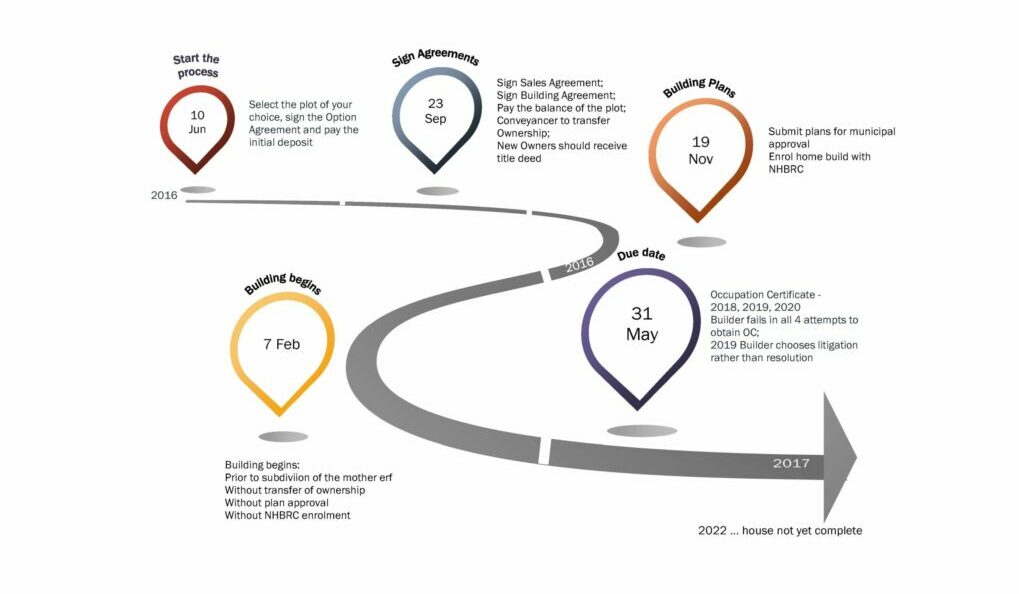
We had 3 agreements to sign to secure our future and home build. First was the Option Agreement where we selected our plot. Next came the Sales Agreement followed closely by the Building Agreement (also called a Building Contract Agreement).
The Sales Agreement authorizes the Sale of the Erf from the owner to the purchaser. Once paid for, the conveyancer proceeds with registration and transfer of ownership. On transfer, the purchaser becomes the owner of the erf and Title Deed. Building can then commence according to the specifications in the building contract agreement.
In our case, as may be common with estate builds, the builder was the developer. We were the first buyers on this new eco estate (as can be seen in our post How We Got Here) and we had to use the developer’s building team. Since then all builds on the estate, save for their spec house, have been done by outside contractors.
AGREEMENTS
The Option Agreement secured our plot in the sectional title development and the type of house we would get. We signed the Sales Agreement and the Building Agreement sometime later. As we are novices to building we naïvely took the developer’s word for all things building. With the agreements we deferred to the “experts” – this time the conveyancer and the developer. The conveyancer should protect the rights of the purchaser as well as the seller. But this conveyancer is the developer’s litigation lawyer and we were wrong to trust her. (Recently we reported her to the Legal Practices Council for misappropriation of trust funds.)
To understand the responsibilities of a conveyancer, read the article The Responsibilities of Conveyancers and Notaries by Allen West of Tonkin Clacey
Prior to signing, I asked a friend who is an Arbitrator if he would read the agreements. His response was:
Regrettably the Building Agreement is, in my opinion, inchoate; it only addresses the contractor’s interests and does little if anything to protect yours.
…
I still urge you to ask for references
REFERENCES AND ASSURANCES
I asked for references but received nothing. I didn’t push the point as we were really keen to get plans passed and building underway. Hindsight is 20-20 vision. We should have insisted on references before signing anything. The builder may not have been able to give a reference as the only other light steel frame structure they had built was their own home, a fact we did not know at the time. Unfortunately, in the village, it is known that “they are always fixing their house”. Not great to hear! Light steel frames with their boards need special skills to get the joints weatherproof and prevent cracking.
I didn’t get references but I did get some reassurance from the developer’s sole director prior to signing:
..[the conveyancer] will now proceed to register the plot to you.
…On registration .. you now are owners of the Title Deed on this ERF … and we can then start building your home.
…The entire build will take approx 4 months at the most ..
SIGN-OFFS
The Architect and Engineer will sign off on each stage to ensure quality of construction and all elements are according to the approved plans and building regulations. All homes are ensured with NHBRC (The National Building Regulating Council) as a further protection for your selves (sic).
FAILURE TO TRANSFER OF THE PLOT
The developer failed to transfer the plot into our names (as per the building contract agreement). Subdivision of the mother erf had been delayed and we had bought a plot that did not actually exist.
If the developer had transferred the plot they would never have been able to submit building plans without our signatures. Without transfer of ownership the developer was the legal owner of the property. We had paid for the plot in full. Our names were on the plans as the “Client” but we were not the legal owners.
NB. THE ATTORNEY SHOULD HAVE DRAWN UP A VARIATION ORDER AS SOON AS SHE KNEW SHE COULD NOT TRANSFER THE ERF TO US.
Make sure all variations are written and signed off by all parties. No matter how much we want to trust someone, safeguard yourself by putting everything in writing.
RESILE CLAUSE
Resile means to pull out of an agreement or contract, in other words, to cancel the agreement. Make sure your building agreement has a resile clause that allows you, the purchaser, to cancel the contract. This is especially important if the builder goes over time with building. In our case the builder stipulated 8 months to build the house. It is over 4 years later and we still cannot live in the house as the builder cannot get an occupation certificate. And, just to make matters worse, there is no resile clause in the building agreement.
NB. THE DEVELOPER’S BUILDING AGREEMENT DOES NOT COMPLY WITH REQUIREMENTS OF THE HOME CONSUMER PROTECTION MEASURES ACT 95 OF 1998.
A NHBRC registered builder must have a resile clause in the agreement. However this builder and developer are a law unto themselves and their contract has no resile clause. Read the post on other NHBRC requirements and the safeguards that should protect you, the consumer.
FRAUDULENT BEHAVIOUR
In recent times the developer tried fraudulently and unethically to re-submit plans in their name, claiming to be the owners. This was 2 years after we became the title deed holders for the property. Had it not been for the vigilance of personnel in the Building Inspector’s office, the developer may have succeeded with this fraud. Our post The Building Inspector has more details about the inspector and the occupation inspections.
FAILURE TO BUILD TO THE APPROVED BUILDING PLANS
They did not build our house according to the approved building plans and they will go to any length not to simply fix it. A sorry state of affairs when the developer is a seasoned vexatious litigant who prefers to waste court time rather than admit faulty workmanship.
NB. THE ATTORNEY SHOULD HAVE DRAWN UP A VARIATION ORDER REGARDING STATUTORY REQUIREMENTS. SHE SHOULD NOT HAVE PAID THE BUILDER BEFORE HAVING PROOF THAT THE BUILDER HAD APPROVED BUILDING PLANS.
Some important clauses in the building contract:
Payment disputes clause 4.7:
Dispute between the parties in respect of the progress payments/ draws:
4.7 (a) In the event that the owner disputes the progress payments / draws payable to the Builder herein, then the Owner must notify the Builder in writing that same is disputed within (5) working days after receiving notice of payments
The attorney never told us of payments made to the builder or drawdowns. That meant we could never dispute any payments. On transfer of the title deed we received a final statement of account from the conveyancing attorney. Only after requesting the information on drawdowns were we told when payments had been made from our funds held in the attorney’s trust account to the developer. The conveyancer should NOT have paid any amount over to the builder prior to transfer of the title deed.
The developer has been over-compensated by 10% as the developer has been paid in full and there is no occupation certificate.
Commencement clause 5.1:
The Builder shall commence construction … upon being notified by the Owner and/or Transferring Attorneys that the plot has been transferred into his name, provided that the Builder shall not be obliged to commence works until:
…
5.1.2 All necessary consents, approvals, registrations and other Authorities have been obtained.
The Builder never transferred the plot into our name nor did the developer get any consents and approvals. He built without approved building plans.
Our alltime favourite clause 4.3(e):
Fifth and final payment being 10% of the purchase price .. to be paid upon obtaining the Occupation
The conveyancer chose to ignore clause 4.3(e) and paid the builder in full without the builder obtaining an occupancy certificate! As the developer has failed to get an Occupation Certificate for the house and, read together with clause 5.5, that means the house is still not complete!
OCCUPATION, COMPLETION AND RISK
5.5 All risk in respect of completed works under this agreement shall pass wholly and entirely to the owner on date of completion as stated in clause 4.3 (e).
7.1 Occupation of the Dwelling House shall be given and taken upon obtaining receipt of the Occupation Certificate as stated in clause 4.3(e) (hereinafter referred to as the “occupation date”).
We still don’t have an occupation certificate after 4 years and 4 inspections! The builder/developer just does not get the fact that the upstairs bedroom and study ceiling is too low. Moreover the builder did not follow the approved building plans and the house does not comply with building regulations. They have stated categorically that they will not alter the roof / ceiling height.
SETTLEMENT OF DISPUTES
… either party shall have the right to refer the dispute to arbitration;
8.1.3 The arbitrator shall be appointed …by the Building Industries Federation SA (now the Master Builders Association) …
The builder and developer spent 3 years delaying arbitration. During those 3 years they sold off most of their assets and opened new companies in place of the old developer. Fortunately we managed to secure some assets and they have finally agreed to arbitration in August 2023 (6 and a half years after the house should have been complete).
CONCLUSION
Make sure that any slight variation to the Building Agreement is in writing in a variation order and signed by all parties. Whether you are late with a payment or the builder starts building before transfer and without approved plans, get the variation order agreed and in writing. Or wait until all consents, approvals and registrations are in place.
Before you agree to a variation order get a legal professional to read it over first. Take advice! You don’t want to regret being a nice person who just signs!
If you have had a good or bad experience with regards to a building contract agreement or dispute settlement, share your experience with us here.
Hello guys, a part of me is glad that there is someone out there who is sharing their ordeal of dealing with janky developers and their corrupt legal agreements. Ofcourse I am terribly sorry that your situation has escalated to the extent it has, as well as the damages you have suffered are insurmountable.
As a first time and young buyer myself, I overlooked a few things with this developer I am currently LOCKED in a OTP agreement with on a new phased build. Of Course similar to your situation my initial thoughts of getting into real estate were for investment purposes, until my partner and I were met with the great news that we are having our first child (daughter). Priorities immediately shifted, and I looked for something with low duty fees (bond & transfer fees).
We came across a new development advertised, and upon contacting the developer we received all the plans and we were immediately blinded by the price as well as the draft plans of our unit of interest as well the greater estate development plans. As inexperienced as we are, we immediately signed the OTP (big mistake) and a bond originator was assigned to us and we on our way to own our first property with the national prime lending rate as low as it is, we jumped at the offer from one of the banks. We signed with the registration lawyers, at this point we thought there is no turning back (This was around march/april 2020).
Back in July we received a construction update that the developer has submitted a request to NHBRC and local council for approval to install services and to begin construction, to this day it’s been complete silence from the developer and his agents. Of course with the national economy recovering from the impact of covid-19 we began to get worried that our ability to capitalise on the real estate market is slowing slipping away because of a developer who fails to give us any confidence in the development. We then decided to do our own research and we came to the conclusion that there are undisclosed politics holding back the development. Knowing what we know now, we proceeded to contact the developer and he still mentions local council as the main drawback to begin construction (i mean not even ground works have begun, still a barren piece of land with a show house)
Sometime last month we contacted the bank and expressed our intent to withdraw from the purchase, the bank advised that we contact the developer, originators and attorneys to each send them a request to cancel. Little did we know notice that we signed an OTP with a cancellation clause of R20 000. Long story short, the OTP only states a cancellation clause penalty on the buyer and nothing is mentioned if the developer defaults how would the buyer be compensated. In essence I am caught between fighting the agreement legally and paying the R20 000 which will save us legal fees.
“4 PENALTY ON CANCELLATION OF AGREEMENT:
4.1 Notwithstanding the rights of the Seller in terms of clause 9 of the Main Agreement,
the Purchaser shall be liable to pay to the Seller an amount of R20 000,00 (twenty
thousand rand) (“the Penalty Amount”) if the agreement between the parties:
4.1.1 is cancelled by the Purchaser; or
4.1.2 is cancelled at the Purchaser’s request; or
4.1.3 is cancelled due to the default of the Purchaser.
4.2 Payment of the Penalty Amount shall become due immediately on cancellation of the
agreement.
4.3 The Conveyancer is hereby authorized to pay any funds that it may be holding in trust
on behalf of the Purchaser to the seller towards the Penalty Amount. If the funds
held in trust are not adequate to settle the Penalty Amount, the Purchaser shall pay
to the Seller the outstanding balance of the Penalty Amount immediately upon
cancellation of the agreement.”
I really do not know what to do because we cannot afford that amount of money to giveaway with a newborn baby bill, and we need to get a house for our family before the prime rate picks up again.
I trust my story is one of many when coming to dealing with real estate developers in this country of ours.
Regards.
Hi Tokologo.
Congratulations of the new baby girl – a wonderful and exciting time of your lives. It should not be spoilt by an unscrupulous builder.
I wonder how many people are being caught in these building agreements that only protect the builder and do little or nothing to protect us, the housing consumers.
Were you told that your plot would be registered to your name before building?
If the builder has not even completed the civils, you may find that, like us, you were sold a plot that does not in fact exist.
The developer and the builder must both be registered with the NHBRC. The NHBRC may be interested to know if your builder is behaving in an unprofessional manner.
Has the conveyancer ensured that the home builder is registered with the NHBRC and has enrolled the home? Have you been shown an enrolment certificate for your build?
Have your plans been approved by the municipality?
There are so many pitfalls and it is so difficult for us the housing consumers. We build one house. The developer knows the ropes and how to get away with things because they do this over and over again.
Take a look at the Government Gazette No 19418, chapter III PROTECTION OF HOUSING CONSUMERS:
https://www.google.com/url?sa=t&rct=j&q=&esrc=s&source=web&cd=&cad=rja&uact=8&ved=2ahUKEwjQ7uW-s6LtAhWrURUIHcIqAiEQFjAAegQIAxAC&url=https%3A%2F%2Fwww.gov.za%2Fdocuments%2Fhousing-consumers-protection-measures-act&usg=AOvVaw1rQAPbh7jjdEu85SXivGZp
Good luck. I hope you get your deposit back without paying lawyers!